A Comprehensive Breakdown of Humanities vs. Natural Sciences Competitiveness
Every spring in Korea, the release of “입결” (ip-gyeol) rankings — the highly anticipated admission cutoff or competitiveness scores — sparks nationwide discussion among high school seniors, parents, and educators.
These rankings, derived primarily from the College Scholastic Ability Test (CSAT/Suneung) results, regular admission (정시) cutoff lines, mock test data, and applicant-to-spot ratios, serve as a real-world barometer of how difficult it is to secure a spot at each university.
Unlike global academic rankings (QS, THE, or SCImago) that emphasize research output and reputation, Korean 입결 rankings focus purely on admissions difficulty and student preference. They reflect not just prestige but also practical factors like major popularity, employment outcomes, and even recent policy shifts such as the expansion of medical schools, semiconductor/AI contract departments, and free-major (무전공) programs.
The 2026 chart we’re analyzing today is a field-specific visualization that separates Humanities (인문계) from Natural Sciences (자연계) — a critical distinction in Korea’s education system, where students choose tracks early in high school and take different CSAT sections. This split reveals fascinating divergences in university strengths that general rankings often obscure.
Below is a full, detailed analysis based directly on the provided 2026 graphic, cross-referenced with broader 2026 admission trends for context, nuances, and real-world implications.
Humanities (인문계) Rankings 2026
This category covers liberal arts, social sciences, business, law, education, and languages — fields where brand reputation, networking, and soft skills often matter more than cutting-edge labs.
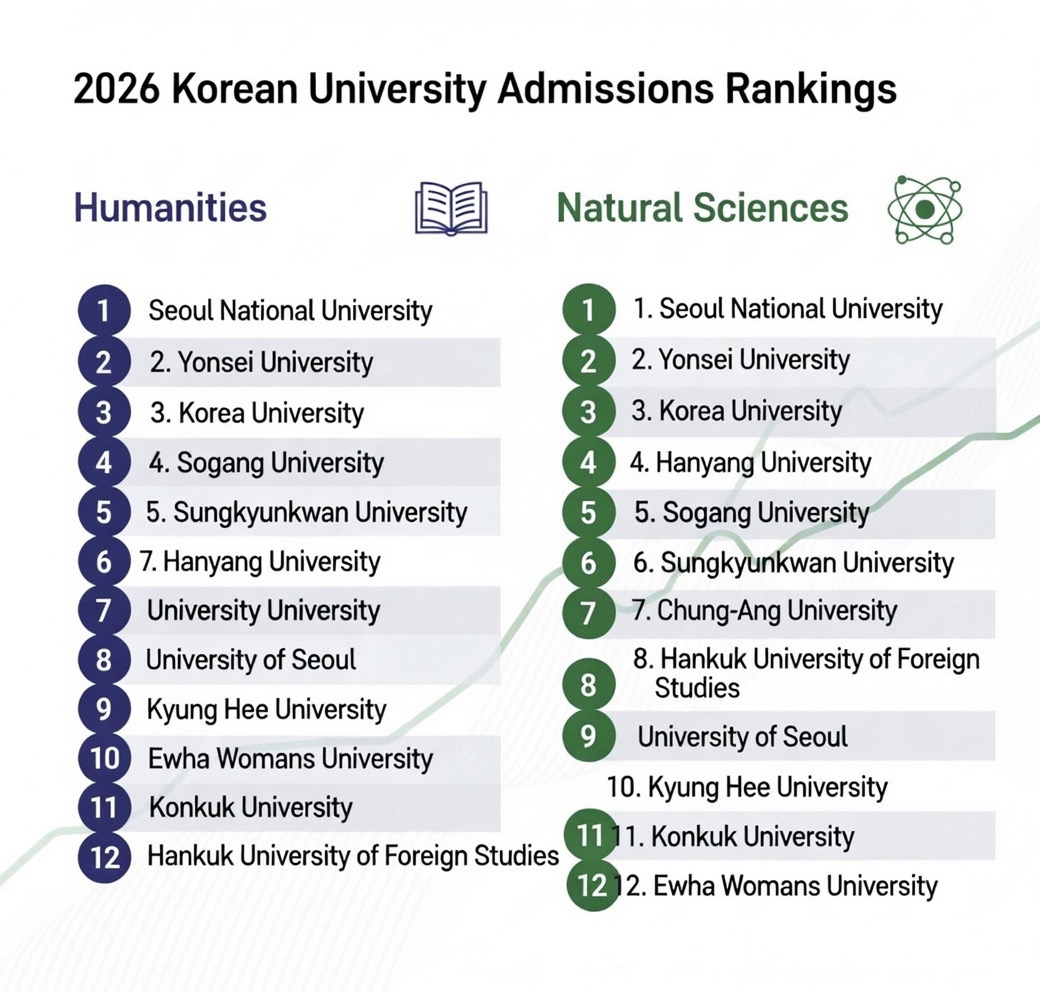
1 Seoul National University (서울대학교)
The undisputed king. SNU’s humanities programs benefit from national prestige, top faculty, and unparalleled alumni networks in government, law, and media.
2 Yonsei University (연세대학교)
Strong in international relations, business, and theology. Yonsei’s global outlook and English-taught courses give it an edge for students eyeing overseas careers.
3 Korea University (고려대학교)
Excels in law, political science, and economics. Korea University’s “KU spirit” and powerful corporate/alumni connections keep it neck-and-neck with Yonsei.
4 Sogang University (서강대학교)
A notable standout. Sogang’s Jesuit tradition and emphasis on critical thinking push it unusually high in humanities — often ahead of larger engineering-focused schools.
5 Sungkyunkwan University (성균관대학교)
Samsung-backed resources and strong global business programs help it maintain a solid top-5 position.
6 Hanyang University (한양대학교)
Rising steadily thanks to its integrated humanities-engineering approach and Seoul campus location.
7–8. University of Seoul (서울시립대학교) / Next-tier institutions (Note: The chart shows minor labeling overlap here, typical in visual summaries)
Public university advantage: lower tuition and strong public administration programs make University of Seoul a practical favorite.
9 Kyung Hee University (경희대학교)
Renowned for hotel management, tourism, and international studies — niche strengths that boost its humanities appeal.
10 Ewha Womans University (이화여자대학교)
Korea’s top women’s university shines in education, design, and languages. Gender-specific support systems give it a unique edge.
11 Konkuk University (건국대학교)
Veterinary science crossover and strong media/communication programs help it hold ground.
12 Hankuk University of Foreign Studies (한국외국어대학교)
Language and area studies powerhouse. Ideal for students targeting diplomacy or global trade, though overall admission lines are slightly lower than SKY.
Natural Sciences (자연계) Rankings 2026
This track includes engineering, medicine, life sciences, physics, chemistry, and emerging fields like AI, semiconductors, and data science — areas where research infrastructure, industry ties, and government funding play huge roles.
1 Seoul National University – Still #1, especially in medicine, engineering, and basic sciences.
2 Yonsei University – Strong medical school and bio-engineering programs.
3 Korea University – Competitive in medicine and applied sciences, though slightly behind Yonsei in some engineering niches.
4 Hanyang University – Major jump from humanities ranking. Hanyang’s engineering reputation (especially mechanical, electrical, and materials science) and industry partnerships make it a natural-sciences powerhouse.
5 Sogang University – Solid but lower than in humanities; excels in computer science and physics.
6 Sungkyunkwan University – Samsung synergy drives semiconductor and AI programs.
7 Chung-Ang University (중앙대학교) – Notable riser with strong pharmacy and media-engineering crossover.
8 Hankuk University of Foreign Studies – Surprising presence due to computational linguistics and data science.
9 University of Seoul – Public funding helps in environmental and urban sciences.
10 Kyung Hee University – Strong in medicine and hospitality-tech hybrids.
11 Konkuk University – Veterinary and bio-sciences focus.
12 Ewha Womans University – Lower placement here reflects heavier emphasis on humanities and life sciences rather than heavy engineering.
Key Comparisons and Nuances
• SKY Lock on Top 3: Seoul National, Yonsei, and Korea University dominate both categories — a pattern unchanged for decades. This reflects their “brand power” (79.1% of humanities applicants prioritize university name over major, per recent surveys).
• Field-Specific Swings:
◦ Sogang University punches above its weight in humanities (traditional strength in liberal arts).
◦ Hanyang climbs dramatically in natural sciences (engineering focus).
◦ Chung-Ang University performs better in sciences thanks to recent investments in AI and biotech.
◦ Women’s universities (Ewha) rank higher in humanities; co-ed technical schools dominate sciences.
• Recent Trends Influencing 2026:
◦ Medical school expansion and “reverse brain drain” to 의대/약대 pulled many high-scoring natural-sciences students away, tightening competition in pure engineering.
◦ Semiconductor/AI contract departments (반도체·AI학과) created new high-cutoff spots at SKKU, Hanyang, and even regional universities.
◦ Free-major (무전공) programs are rising in popularity, blurring lines between tracks.
◦ Humanities competition intensified in 2026 (8.5% more 수시 dropouts flowing into 정시), while natural sciences saw slightly less pressure.
Implications for Students, Parents, and the Education System
For Applicants (2026 & Beyond):
Choose your track wisely. A student strong in math/physics might target Hanyang or SKKU for better odds than chasing Yonsei in humanities. Conversely, language-loving students may find Sogang or Hankuk Foreign Studies more attainable than Korea University’s ultra-competitive business track. Always check department-specific cutoffs — overall university rank ≠ major rank.
Career & Employment Angle:
Humanities grads from top schools dominate law, finance, media, and civil service (고시). Natural sciences grads feed into Samsung, Hyundai, and tech giants, with semiconductor/AI roles offering starting salaries 20–30% higher in some cases. Long-term, SKY alumni networks remain the ultimate “soft power.”
Broader Societal Considerations:
• Equity Issues: Public universities (University of Seoul) and women’s universities provide important alternatives for students from non-elite high schools.
• Regional Imbalance: Seoul dominance continues; local national universities (부산대, 경북대) rarely crack top national 입결 charts despite strong local programs.
• International Students: These rankings matter less for foreigners (who often use separate tracks), but SKY and top privates still offer generous scholarships for STEM to attract global talent.
• Edge Cases: Students with disabilities or from rural areas benefit from special admissions quotas. Medical/dental tracks remain the ultimate “safe high-score” path regardless of category.
Practical Advice for Future Applicants:
1 Use mock CSAT results to simulate your position against these cutoffs.
2 Look beyond overall rank — check department-specific data on university websites or Naver admissions communities.
3 Consider “safe + aspirational” strategy: one reach school, two match, one safety.
4 Monitor policy changes: 2027+ may see more AI/quantum and climate-tech emphasis in natural sciences.
The 2026 입결 chart confirms what Koreans have long known: prestige is king, but field-specific strengths create real opportunities for strategic choice. Whether you dream of becoming a diplomat (humanities route) or an AI engineer (natural sciences route), these rankings are your roadmap — not a destiny.
(Updated March 2026 — data synthesized from official admission results and public visualizations.)
'교육' 카테고리의 다른 글
| 2026 국내 대학 입결 서열 순위(초판) (0) | 2026.03.19 |
|---|---|
| 2026年韩国大学录取排名深度解析:人文科学 vs 自然科学竞争力全面对比 (0) | 2026.03.13 |
| [2026 대학 입결 순위] 의치한약수 vs 서울대 vs 계약학과 대학 입결 서열 (GS 누백) (0) | 2026.02.17 |
| 교육제도 개편에 따른 향후 5세 아이의 교육 방향은 독서 중심 (0) | 2026.01.09 |
| [대입 정보] 주요대학 취업률 순위 (0) | 2026.01.09 |


