China’s CXMT (Changxin Memory Technologies) just went public on the Shanghai Stock Exchange. The South Korean media responded with their usual refrains: "The technology gap is still huge," and "We're still ahead in HBM." But if you look past the surface, this IPO isn't about who leads today. It’s a stark signal that South Korea needs to drop its "Memory Powerhouse" hubris and face a harsh new reality.
1. South Korea is Stuck at the "Tail End" of the Semiconductor Ecosystem – Just Like Steel and Petrochemicals Once Were
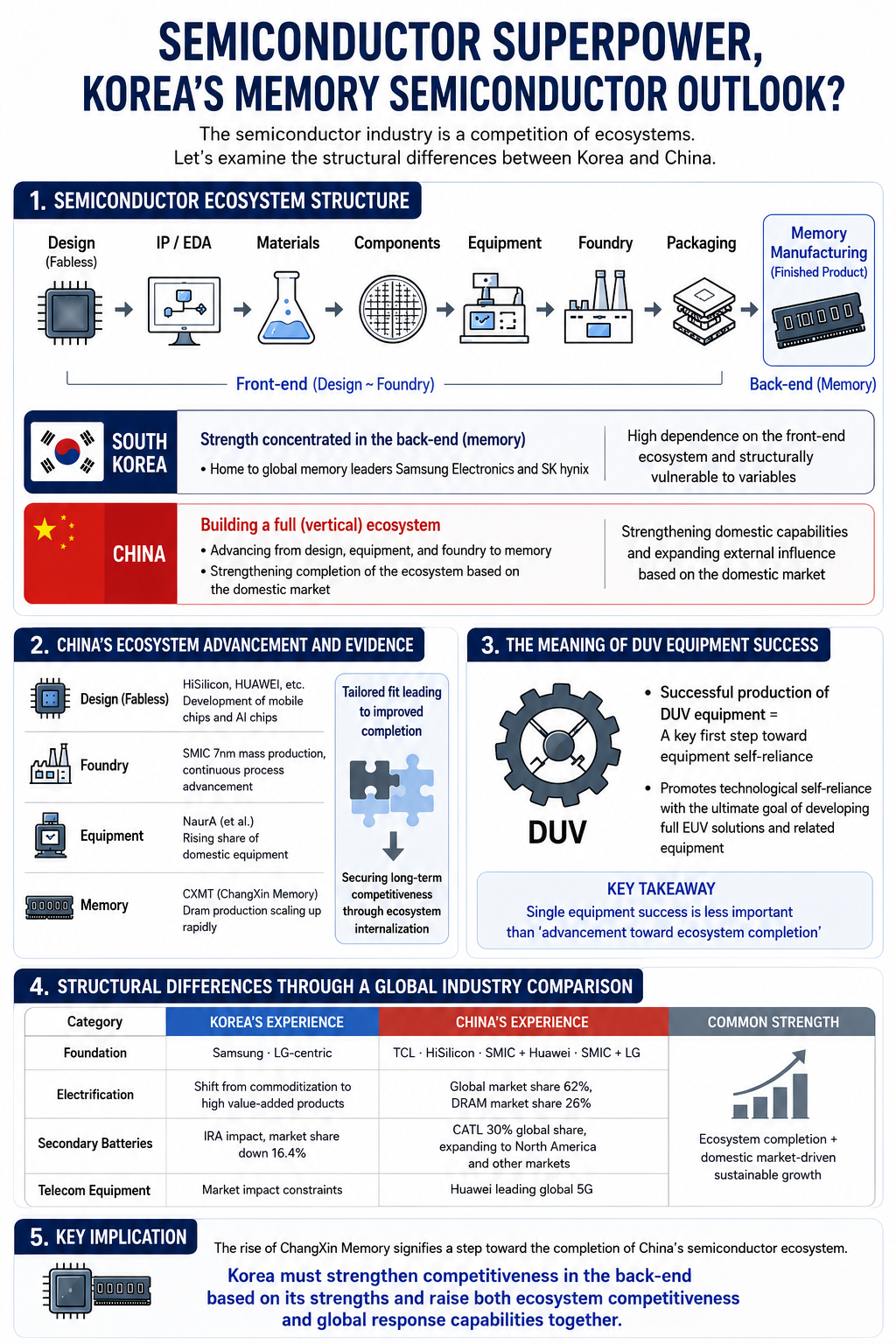
Many Koreans proudly call their nation a "semiconductor superpower." But that title only applies to one narrow field: memory manufacturing (DRAM and NAND). The semiconductor ecosystem includes fabless design, materials, components, equipment, foundry, packaging, and more. South Korea has bet everything on the very last step of this chain—finished memory products.
We've seen this movie before. Remember steel? POSCO once dominated the globe, yet now it's closing down its Pohang Plant 1 amid a flood of cheap Chinese imports, with exports to the US plummeting by 26%. Remember petrochemicals? The Korean industry is now resorting to "joint production cuts to avoid mutual destruction" as China’s oversupply crushes margins. In both cases, Korea was "number one" until China completed its own ecosystem and ate Korea's lunch. Semiconductors are simply the next domino in this pattern—a precarious "perch at the top of a hundred-foot pole" that could crumble at any moment.
2. China is Assembling a "Full Ecosystem"—and Has Already Done It in Home Appliances, EVs, and Telecom
What is China doing? While CXMT makes DRAM, China is simultaneously pushing SMIC (foundry), Huawei (fabless), and domestic equipment makers (like NAURA) to build a complete, integrated puzzle. They aren't just making "one product"; they are building a closed-loop system.
This strategy is proven. Look at home appliances: In 2024, the combined global TV market share of China’s TCL, Hisense, and Xiaomi (31.2%) overtook Samsung and LG (28.4%) for the first time in history. Look at electric vehicles: Chinese brands now command 62% of the global EV market, exporting over 2.6 million units last year. Look at telecom equipment: Huawei is the undisputed global leader in 5G. In every case, China didn't just win on price—they won by controlling the supply chain, materials, and domestic demand. CXMT is just the latest piece of that sprawling puzzle.
3. The DUV Prototype Success Isn't a "Machine"—It’s a Declaration of Independence
News broke that China has successfully produced a prototype of its own DUV lithography machine. Korean media immediately downplayed it, sneering that "it's no match for ASML." But they are missing the forest for the trees.
This isn't about catching ASML overnight. It's a declaration that China can overcome US export bans on EUV by leveraging multi-patterning and domestic equipment. This mirrors exactly what happened in batteries. South Korea’s top three battery makers (LG, SK, Samsung) saw their global market share plummet to just 16.4% as they got caught up in US IRA regulations. Meanwhile, China’s CATL shrugged off external pressure, used the domestic market as a shield, and pushed its market share past 30%. China turns external restrictions into fuel for self-reliance. The DUV prototype is proof that they are completing the puzzle—and once it's fully assembled, Korea’s supply chain leverage disappears.
4. South Korea is "US-Dependent," While China is Immune to External Variables
Korea’s memory industry is riding the AI wave right now, but its fortune is entirely hostage to US Big Tech’s capex and US government policies. When Washington changes regulations, Seoul trembles. When the US offers subsidies, Korean companies rush to build factories in America. Even in smartphones, Samsung—once the undisputed king—lost its global crown to Apple and dropped to third place in India, overtaken by Vivo and Xiaomi. The pattern is clear: Korea’s "global strategy" has merely become a satellite of US interests.
China operates differently. External sanctions don’t cause panic in Beijing. The domestic market is massive, and state policy is unwavering. They treat "exogenous variables" (like US sanctions) as checkpoints, not roadblocks. They keep solving their long-term puzzle regardless of who is in the White House.
5. Stop the Panic, Drop the Arrogance, and Avoid "Competitive Flailing"
Some Korean experts are either complacent ("we still lead in tech") or panicking ("we need to align even closer with the US to block China"). This latter approach—what I call "competitive flailing"—is a strategic trap. It only closes the door to the Chinese market without offering a sustainable solution.
Just look at the track record. Steel, petrochemicals, smartphones, secondary batteries, home appliances, electric vehicles, and telecom equipment—in every single sector, Koreans said, "This time is different," or "The technological gap is too big to close." Yet China caught up and surpassed them every time.
The current memory boom is just a fleeting moment of luck, propped up by AI-driven shortages and US-China tech decoupling. It is not a permanent fortress. China is playing the long game, building an ecosystem over the next decade. South Korea is stuck defending a single castle (memory) while relying on a foreign general (the US) for reinforcements.
History is screaming at us: Korea's 'unassailable' industries always fall. It's time for the semiconductor industry to listen before it becomes the next chapter in that history.
'경제와 산업' 카테고리의 다른 글
| 메모리반도체 국가별 시장 점유율 추이 미국 일본 한국 중국 (0) | 2026.08.01 |
|---|---|
| CXMT上市不只是新闻,而是给韩国半导体的一记警钟 (0) | 2026.07.29 |
| 중국은 절대 못따라잡는다는 믿음 : 창신메모리 상장 즈음에 (0) | 2026.07.29 |
| 금융권의 꽃 4대 시중은행 상근임원 출신 대학 순위 (2026년 1분기) (0) | 2026.07.23 |
| 한국 vs 중국 12대 산업 분야 비교 반도체 조선 철강 화학 2차전지 등 (0) | 2026.07.13 |


