Background: Coupang Data Breach and National Assembly Hearing
Coupang’s headquarters in Seoul. The company faced a massive data breach in late 2025, prompting government scrutiny.
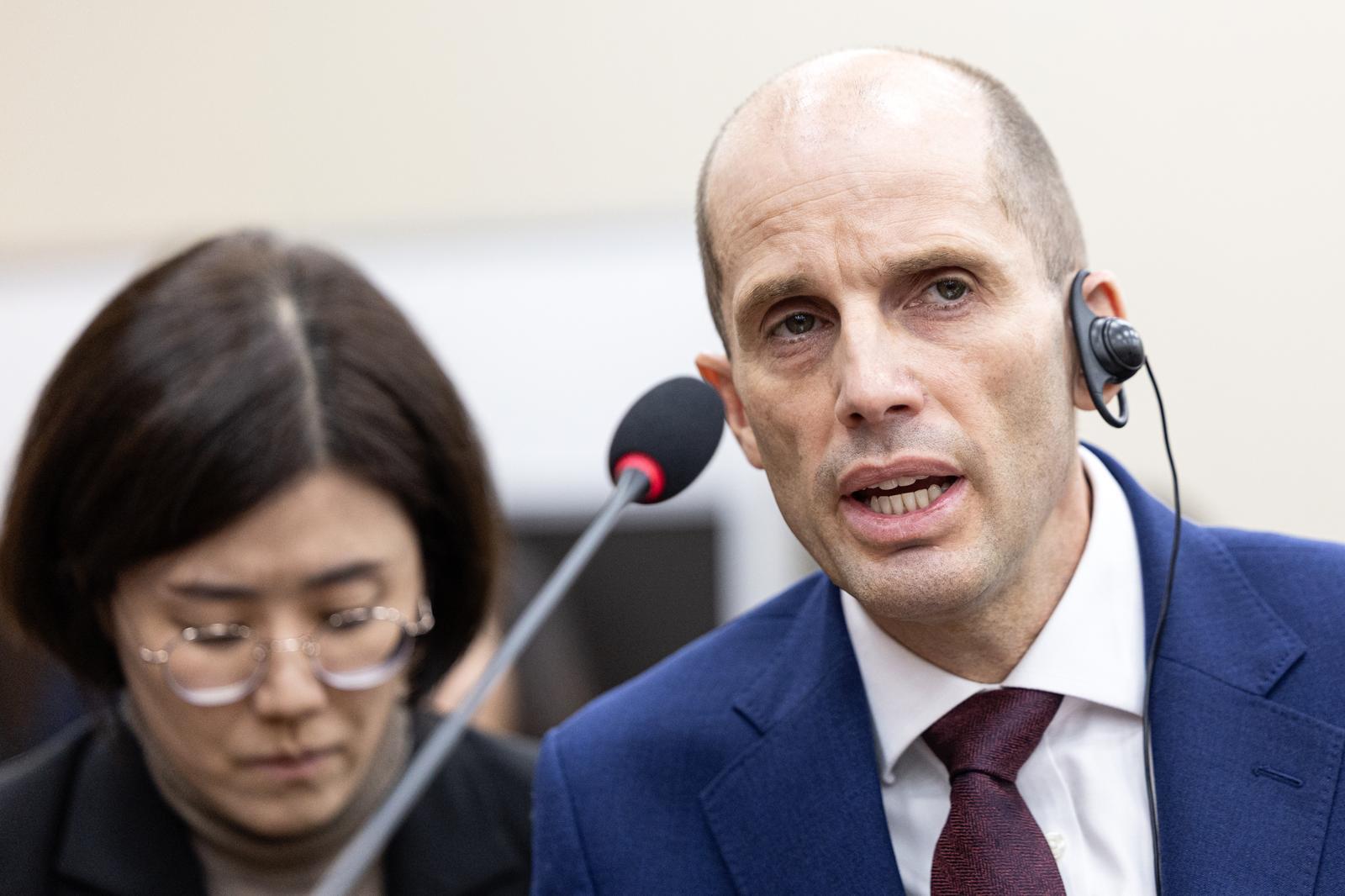
In November 2025, e-commerce giant Coupang disclosed a major data breach impacting tens of millions of customer accounts. This incident led to a joint parliamentary hearing at South Korea’s National Assembly to investigate the breach, Coupang’s handling of it, and related issues like unfair trade and labor conditions. The hearing, held on December 30–31, 2025, saw Harold Rogers – an American citizen and Coupang’s interim CEO – testify on behalf of the company. Notably, Coupang’s founder Kim Beom-seok (Bom Kim) and other key witnesses did not attend, which drew criticism  . Rogers, who was sworn in before testifying, answered lawmakers’ questions through an interpreter. During the proceedings, he made a controversial claim regarding the company’s response to the breach that has since been called into question .
Rogers’ Testimony and the Perjury Allegation
At the hearing, lawmakers probed why Coupang had contacted the suspected hacker and conducted its own investigation instead of deferring entirely to law enforcement. In response, Harold Rogers claimed that a government agency instructed Coupang’s actions, saying: “The government agency instructed us, and we did what the government agency told us to do.”  He specified that the National Intelligence Service (NIS) – South Korea’s spy agency – had directly guided Coupang’s team to meet the data-leak suspect and even to make a forensic copy of the suspect’s hard drive . However, the NIS immediately refuted Rogers’ statements, issuing a press release characterizing his testimony as “completely false.” The NIS stated that aside from requesting some data, it “never ordered, instructed nor permitted any actions by Coupang” and was “not in a position to take such an action.”  In fact, the NIS revealed that Coupang had already made a copy of the suspect’s hard drive before the agency was even involved, contradicting Rogers’ narrative . This stark discrepancy raised suspicions that Rogers knowingly gave false testimony under oath.
South Korean lawmakers and officials were quick to label Rogers’ disputed claim as potential perjury. Lying under oath in a parliamentary hearing is a serious offense in Korea. Choi Min-hee, the committee chair (and a National Assembly member), noted that the NIS Director had directly contacted her during the hearing, urging that Rogers be accused of perjury and providing details of the false statements. Choi announced that the committee would formally address the perjury issue by the conclusion of the hearings, signaling that a formal complaint would be filed against Rogers for lying to the National Assembly. Indeed, by the second day of the hearing (Dec. 31), the committee prepared to adopt a resolution to accuse Rogers of perjury and forward the case to prosecutors .
Does Rogers’ Statement Qualify as Perjury?
Under Korean law, perjury is defined as making false statements under oath in an official proceeding. The Act on Testimony and Appraisal Before the National Assembly (국회에서의 증언·감정 등에 관한 법률) governs parliamentary hearings. Witnesses like Rogers must swear to tell the truth and even sign a pledge acknowledging that any false testimony can be punished . Given that Rogers spoke under oath, the key question is whether his statements about the NIS were knowingly false. The NIS’s firm denial and evidence (such as timeline inconsistencies) suggest that Rogers’s testimony directly contradicted the facts . If it is proven that Rogers willfully lied – rather than merely misspoke or misunderstood – then his statements do constitute perjury under Korean law.
It appears likely that Rogers’s testimony meets the threshold for perjury. He alleged specific government instructions that the agency emphatically insists never happened . The situation isn’t a trivial discrepancy but a fundamental false claim about government involvement. Moreover, Rogers, as Coupang’s interim chief and a legal professional (he also serves as Coupang’s General Counsel), would be expected to understand the gravity of testifying truthfully. He even acknowledged in writing before testifying that false statements would carry penalties . The coordinated response by the National Intelligence Service and Korean lawmakers indicates they view his claim as a “clear falsehood” made under oath – in other words, perjury. Barring any exculpatory explanation from Rogers (for example, if he somehow misinterpreted the NIS’s actions as orders), the National Assembly committee is treating his testimony as perjurious and is moving to take legal action .
Legal Consequences of Perjury in a National Assembly Hearing
South Korea takes false testimony in official proceedings very seriously. According to Article 14 of the Act on Testimony and Appraisal Before the National Assembly, a witness who gives false sworn testimony at a parliamentary hearing faces significant criminal penalties . The law stipulates a **prison term of at least one year and up to 10 years for perjury in this context . In other words, if convicted, Rogers would be looking at a felony-level punishment, potentially a multi-year prison sentence. There is no minor slap-on-the-wrist fine; the punishment is incarceration, reflecting the view that lying to the legislature undermines the democratic process.
The procedure for handling this is as follows: the National Assembly committee overseeing the hearing holds the authority to formally accuse a witness of perjury and refer the case to law enforcement . Once the committee adopts a resolution to file a perjury charge, it will forward the case to the prosecutors (through the police) for investigation and indictment. In Rogers’ case, the NIS specifically requested that the Assembly committee exercise this power and lodge a formal complaint against him for perjury . The committee chair agreed, and a vote was expected at the end of the session to authorize the complaint. After that, prosecutors and courts would handle the process: an investigation, potential indictment, trial, and if found guilty, sentencing.
It’s worth noting that perjury in a parliamentary hearing is treated similarly to perjury in court in terms of severity – in fact, the maximum penalty (10 years) is even higher than the typical maximum for perjury in judicial proceedings (which is 5 years in many jurisdictions). This underscores the lawmakers’ intent to deter witnesses from deceiving legislative inquiries. Rogers’s case would be one of the rare instances of a foreign corporate executive facing such charges in Korea’s National Assembly. Past Korean corporate figures have indeed been prosecuted for perjuring themselves before parliamentary committees (for example, during chaebol hearings), so there is precedent for serious consequences. If Rogers is indicted, he would be tried under Korean criminal law, and if convicted, the judges would determine the exact prison term within the 1-10 year range based on factors like the impact of the lie and whether he admits fault.
Punishment and Jurisdiction Issues for an American Citizen
A key point of interest is that Harold Rogers is a U.S. citizen. Does his foreign nationality affect the ability of South Korea to punish him? In general, Korean law applies to anyone on Korean soil who commits a crime there – citizenship is largely irrelevant for jurisdiction. By testifying (and allegedly lying) in the National Assembly in Seoul, Rogers placed himself under Korean jurisdiction. Therefore, being an American does not exempt him from prosecution for perjury in Korea. If the National Assembly files a complaint and prosecutors indict Rogers, he would be tried in Korean court like any other defendant. If found guilty, he could be sentenced to prison in Korea, even though he is not a Korean national . There is no special immunity for foreign corporate officers in such proceedings.
However, Rogers’s nationality and international status do raise practical considerations. One concern is ensuring he remains available to face investigation and possible trial. Korean authorities have moved quickly to prevent Rogers from leaving the country. During the hearing on Dec. 30, lawmakers directly asked the police to consider an exit ban (travel restriction) on Rogers to keep him in Korea pending legal action. In response, the Acting Commissioner General of the National Police stated he would proceed “swiftly according to law and procedure” to bar Rogers from departing South Korea . This implies that Rogers may be placed on an immigration watchlist, stopping him from any attempt to fly back to the United States or elsewhere until the matter is resolved. In fact, even outside of government action, a group of victims of the data breach filed a legal complaint that urged authorities to “immediately ban all Coupang executives and employees, including CEO Harold Rogers, from leaving the country.”  There is clearly a strong impetus to keep him within Korean jurisdiction.
If Rogers were to leave South Korea before or despite these measures, it would complicate matters. South Korea does have an extradition treaty with the United States, so in theory he could be extradited back to Korea to face charges, but extradition is a complex and lengthy process. It typically requires that the offense be a crime in both countries and sufficiently serious. Perjury resulting in a potential 10-year sentence would likely be considered an extraditable offense (since it meets seriousness criteria). Korean authorities have indicated they will use “all means, including international criminal justice cooperation” to bring individuals to justice if necessary . This statement was made in the context of summoning Coupang’s founder (who is also abroad in the U.S.), but it underscores that Korea is prepared to invoke international agreements if key figures attempt to evade legal accountability overseas. In Rogers’s case, should he flee to the U.S., prosecutors could seek help under the treaty to have him returned. That said, such a step would only be taken if he absconds; as long as he stays in Korea and complies, the process will proceed domestically.
It’s also important to note that Rogers does not have diplomatic immunity or any special status – he is a private businessman. Thus, he has no legal shield from Korean law due to citizenship. The fact that he is American might draw international attention, but legally he will be treated under the Korean criminal justice system. Any eventual prison sentence would be served in Korea under Korean authorities. Only after serving any sentence or if charges were dropped would he be free to leave the country.
In summary, Harold Rogers’s statements at the National Assembly hearing are very likely to be deemed perjury, given the direct evidence and denials from the NIS. Perjury at a parliamentary hearing is a crime in Korea, punishable by 1 to 10 years in prison , and the National Assembly is moving to ensure he faces those consequences. Rogers’s status as an American citizen does not prevent Korean prosecutors from charging or punishing him; as the incident took place under Korean jurisdiction, he is subject to Korean law. The main implication of his foreign citizenship is the added step of preventing any international flight to avoid prosecution – a step Korean authorities are already pursuing through travel bans  . If he stays in country (or is brought back via cooperation), he will likely face a trial for perjury just as a Korean would, and could serve jail time in Korea if convicted . The “Coupang hearing” controversy serves as a clear message that lying under oath to the Korean National Assembly can lead to serious legal repercussions, regardless of one’s nationality  .
Sources
• Hyeon Ye-seul, “Intelligence service asks parliament to charge Coupang interim chief with perjury,” Korea JoongAng Daily, Dec. 30, 2025  .
• Newsis (via Daum News), “Police consider travel ban for Coupang’s Rogers amid perjury controversy,” Dec. 30, 2025 .
• Jang Seulgi, “[단독] 청문회 자료 ‘나 몰라라’ 쿠팡…미국엔 긴급 보고서” (MBC News), Dec. 17, 2025 .
• Lee Seungyoon, “Law firm seeks travel ban on Coupang execs, files complaint over data leak cover-up,” Maeil Business Newspaper, Dec. 26, 2025 .
'사회와 정치' 카테고리의 다른 글
| 쿠팡 개인정보 유출 청문회: 국정원의 입장 변화와 향후 전망 (0) | 2025.12.31 |
|---|---|
| [닐의 통찰] 쿠팡 개인정보 유출 사건: 국정원의 비공식 개입과 책임 논란 (0) | 2025.12.31 |
| 국정원-쿠팡 ‘사이버 안보 위협’ 공문 사건 조사와 논란 (0) | 2025.12.30 |
| Mounting Allegations Against Kim Byung-ki and Calls for Resignation (0) | 2025.12.29 |
| 김병기 의원-대한항공 특혜 의혹 논란과 이젠 결정의 시간 (0) | 2025.12.29 |


