Introduction
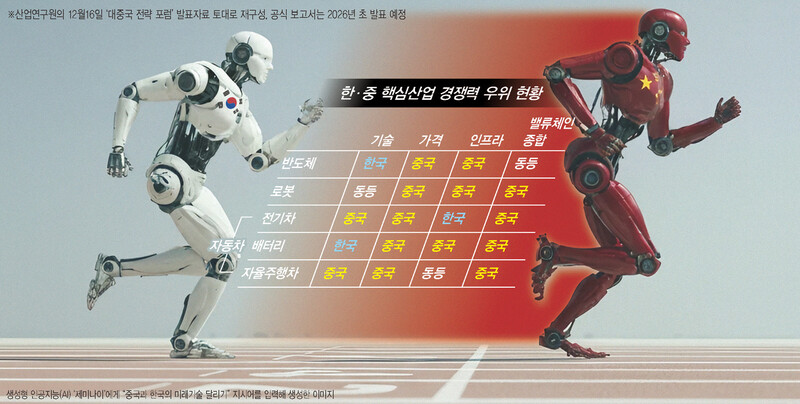
South Korea has long been a powerhouse in key high-tech industries like semiconductors, automobiles, and batteries. However, new findings from a Korean state research institute indicate that China has caught up to – or even surpassed – South Korea in several of these advanced sectors  . In particular, China’s strides in semiconductors, electric vehicles (EVs), batteries, robotics, and autonomous driving have eroded South Korea’s traditional competitive advantages. This report provides a detailed analysis of China’s rapid progress in these industries, the areas where South Korea still maintains an edge, and the implications for the future. The evidence suggests that without strategic adaptation, the competitiveness gap may continue to widen in China’s favor .
Semiconductor Industry: Korea’s Memory Lead vs China’s System Chip Surge
Semiconductors are the backbone of South Korea’s economy, with Korean firms dominating memory chips (like DRAM and NAND flash). South Korea still holds a “absolute advantage” in memory semiconductor technology and market share . For instance, Korean companies control ~65% of the global memory market  . However, in logic and system chips – including processors and AI accelerators – China has made remarkable gains.
Value Chain Comparison: According to the industrial research institute’s assessment, China’s overall competitiveness in semiconductors is now on par with South Korea . Out of 8 major value-chain segments evaluated in the chip industry, China leads in four – specifically:
• Chip R&D (design and research) – China’s capabilities in chip design have grown rapidly, aided by a huge pool of engineers and companies.
• Chip fabrication (manufacturing) – China has expanded its semiconductor fabrication capacity significantly in recent years, closing the gap in production infrastructure  .
• Product services – Chinese firms offer strong support and services around chips, leveraging their integrated supply chains.
• Domestic demand – China’s vast internal market for semiconductors (from smartphones to AI data centers) gives it an advantage in scale of demand.
In contrast, South Korea led in only two value-chain categories: securing materials/equipment (supply chain) and overseas export demand . These are areas where U.S. sanctions hinder China – for example, Chinese chipmakers face restrictions obtaining certain high-end fab equipment and exporting advanced chips abroad, which has given Korean firms a temporary edge in supply chain stability . But aside from those sanction-affected factors, “there is virtually no unique strength left that only South Korea holds” in semiconductors . This underscores how thoroughly China has caught up in most aspects of the chip industry.
Technical and Infrastructure Metrics: The report drilled down into 30 detailed metrics across technology, price, and infrastructure for semiconductors. China came out ahead in 19 of 30 metrics (about 63%) . In other words, on nearly two-thirds of specific measures – from cost-performance (price per chip capability) to manufacturing infrastructure – China holds the upper hand. South Korea’s remaining advantages are largely confined to a few technical areas like the cutting-edge process technology for memory fabrication and advanced foundry (contract chip manufacturing) . Indeed, if one excludes memory manufacturing and leading-edge foundry process (where Korea’s Samsung Electronics and SK Hynix still excel), China is “overwhelmingly competitive” in most other aspects thanks to better cost-effectiveness and massive infrastructure investments .
One vivid sign of China’s progress is in advanced chip design, particularly chips powering artificial intelligence. In the AI chip design segment, China is now rated superior to Korea in all dimensions – technology, price, and infrastructure . Chinese tech giants like Huawei and dedicated fabless firms like Cambricon have successfully developed high-performance AI semiconductors domestically, achieving a level of self-reliance that few expected so soon . Huawei, for example, surprised industry observers by releasing new smartphones in 2023–2024 with advanced 7-nanometer Kirin system-on-chips made in China, despite U.S. export bans  . This kind of breakthrough reflects China’s resilience and innovation in chips. The result: South Korea, which does not have a strong native AI chip industry, may even find itself importing cutting-edge Chinese chips in the near future . In fact, an expert noted that Chinese firms have succeeded in achieving “AI chip independence,” raising the prospect that “Korea might have to buy Chinese advanced semiconductors to use” .
Fabless Ecosystem Scale: A major factor behind China’s strength in chip design is the sheer scale of its fabless ecosystem (chip design companies without their own fabs). China is home to over 3,500 fabless semiconductor firms, an astonishing number that dwarfs South Korea’s <150 fabless companies . This roughly 20-to-1 disparity means China has a vast talent pool and startup ecosystem iterating on chip designs for every imaginable application. “China’s goal isn’t to export chips, but to supply its huge domestic needs,” observes Prof. Lee Woo-geun, a semiconductor expert who taught in Tsinghua University’s chip program . Yet even without prioritizing exports, China’s enormous domestic market and armies of chip designers give it tremendous “self-sufficiency and potential” compared to Korea’s much smaller base . This suggests that China’s system semiconductor lead is likely to grow as its fabless companies innovate and benefit from economies of scale that Korea cannot easily match.
Memory vs Logic Split: South Korea’s remaining dominance in memory chips (DRAM/NAND) still stands – these are areas where decades of manufacturing expertise keep Korean firms ahead in yield and density. However, memory is a relatively narrower segment of the industry. The more strategic battleground now is logic chips and AI accelerators, which drive everything from smartphones to cloud AI – and here China is pulling ahead. Even in foundry (contract manufacturing of logic chips), China’s capabilities (e.g. SMIC’s advancing nodes) are improving despite sanctions, while Korean foundries beyond Samsung remain limited. The report’s finding that China’s semiconductor competitiveness is “equal” to Korea’s overall  reflects how Korea’s strength in memory is now balanced out by China’s prowess in logic design, manufacturing capacity, and cost advantage in other chip types.
It’s telling that China’s leadership has publicly celebrated these gains. In his New Year’s address on Dec 31, 2025, President Xi Jinping highlighted “breakthroughs in indigenous semiconductor R&D” and China’s rapid progress in large AI models  . Xi declared that “China has become one of the world’s fastest-growing countries in terms of innovative capacity,” emphasizing tech achievements in chips and AI . This national focus on semiconductor innovation – amid U.S. attempts to restrain China’s chip sector – underscores that China is not just catching up but determined to lead. South Korea, despite its semiconductor legacy, now finds itself challenged by a new tech superpower with equal or greater strengths across much of the chip value chain.
Electric Vehicles and Batteries: China’s Dominance
The automotive sector – especially electric vehicles – is another area where China has leapfrogged ahead of South Korea in recent years. The institute’s comparison of EV-related industries (which includes electric cars, batteries, and autonomous driving vehicles) showed China outpacing Korea at every stage from R&D and supply chain to production and market demand . All indicators point to China being the world’s EV powerhouse, whereas South Korea, despite having global automakers (Hyundai/Kia) and battery champions, is now playing catch-up.
Electric Vehicle Production & Sales: China is by far the largest EV producer and market on the planet. By 2024, almost two-thirds of all electric cars sold worldwide were in China . Over 11 million EVs were sold in China in 2024, an increase of ~40% year-on-year, and nearly 50% of all new cars sold in China in 2024 were electric . This dwarfs South Korea’s EV market (which is growing but much smaller). Chinese automakers like BYD, NIO, Xpeng, Geely, SAIC and others collectively offer a vast range of models, often at very competitive prices. In fact, BYD overtook Tesla as the world’s #1 EV maker by volume, selling around 1.8 million fully electric cars in 2025 (plus additional plug-in hybrids)  . South Korea’s flagship automaker Hyundai Motor, by contrast, sold roughly 300,000 EVs in 2025 (including Kia), far behind the Chinese numbers. The market scale strongly favors China – a massive domestic customer base that encourages high-volume production and cost reductions. This translates into a price advantage: Chinese EVs often cost significantly less than equivalent models from Korea, yet offer similar technology, giving China an edge in price-to-performance (“가성비”) .
South Korean companies have acknowledged China’s surge. Hyundai’s leadership has observed that China is not only the biggest EV market but also increasingly exporting EVs globally, threatening Korean automakers in markets like Europe. In 2023-2025, Chinese brands (BYD, MG/SAIC, Geely’s brands, etc.) began outselling competitors in some markets by offering affordable EVs with good range, thanks to China’s domestic scale and supply chain integration. China’s EV ecosystem benefits from strong state support, consumer subsidies (e.g. purchase incentives, which boosted EV adoption to over 10 million units ), and local supply of critical components.
Battery Industry Leadership: Perhaps even more crucial than assembling cars is the battery supply chain, where China also leads decisively. Batteries are the heart of EVs, and Chinese firms have become the world’s top battery manufacturers. Contemporary Amperex Technology Co. Ltd. (CATL) of China is the undisputed global leader in EV batteries, supplying about 38% of the world’s EV batteries as of 2025 . Hot on its heels is China’s BYD, which not only makes cars but also produces its own batteries; BYD held around 17% global market share in 2025 . In total, data from SNE Research shows that six Chinese battery makers now account for ~69% of all EV batteries installed worldwide (Jan–Oct 2025) . This dominance reflects how Chinese companies have both scale and technological prowess – from LFP (lithium iron phosphate) battery chemistry, which Chinese firms commercialized widely for lower cost, to heavy investments in next-generation cells.
By contrast, South Korea’s big battery companies – LG Energy Solution, Samsung SDI, and SK On – are struggling to keep up. LG Energy Solution, the largest Korean player, held only about 9.3% of the global EV battery market in 2025, with its share declining as Chinese firms expanded . The combined share of Korean and Japanese battery makers has been shrinking year by year . Korean batteries are still used by many automakers (LG supplies Tesla, GM; SK supplies Ford, Hyundai; etc.), but Chinese battery giants often undercut on price or integrate vertically (as BYD does) to lower costs. Moreover, China controls much of the battery materials supply chain (from lithium refining to cathode materials), reinforcing its dominance. South Korea, despite strong R&D in high-performance batteries, cannot easily compete with the scale and cost structure of China’s battery industry.
The infrastructure and supply chain strength of China in EVs is evident. The research comparison gave China higher scores in every segment of the EV/battery value chain – R&D, components procurement, vehicle production, after-sales service, and market demand . For example, battery materials and cell production in China benefit from domestic mining and refining (China processes >60% of global lithium, cobalt, etc.), extensive cathode/anode manufacturing, and huge factories (CATL operates “gigafactories” that rival or exceed any in Korea). Additionally, the EV charging infrastructure in China has grown rapidly (with millions of chargers installed), making EV adoption easier domestically than in Korea.
Quantitative Competitiveness Scores: The report quantified the overall competitiveness in these sectors on a 7-point scale (with >4 favoring China, <4 favoring Korea). The results were striking:
• Autonomous vehicles: 5.3 (China far ahead) 
• Robotics: 5.0 (China ahead) 
• Electric vehicles: 5.0 (China ahead) 
• Batteries: 4.8 (China slightly ahead) 
All these scores are above the neutral 4.0 midpoint, indicating China outperforms Korea in all these high-tech automotive fields. In particular, the EV and battery scores (~5.0) show a clear Chinese edge. By comparison, none of these categories scored below 4 in Korea’s favor. South Korea’s automotive industry (including EVs) was once a pillar of its economy, but these findings reveal it has been overtaken by China in both current capability and future potential .
It’s worth noting that China has also begun setting global standards in emerging automotive technology. On December 30, 2025, China’s industry authorities released a draft for the world’s first national standard for EV solid-state batteries  . Solid-state batteries are considered the “dream battery” of the future due to higher energy density and safety, and no country (including Korea) has commercialized them yet. By proactively defining standards (terminology, classifications, testing methods) for solid-state EV batteries, China is positioning itself to lead the world in next-gen battery commercialization  . This kind of move – establishing standards ahead of international bodies – exemplifies China’s strategic foresight and confidence in the EV/battery arena. It also signals to Korean companies that China intends not just to compete on products, but to shape the rules of the game in future technologies.
Robotics and Autonomous Driving: China’s Lead in Smart Tech
Beyond chips and cars, robotics and autonomous vehicles are key industries of the future – and here too, China has surpassed South Korea. The robot industry (including industrial and service robots) and self-driving car technology are areas where China’s progress has been particularly “rapid and conspicuous,” according to the study . South Korea, despite being an early adopter of robots in manufacturing and having strong ICT firms, is now lagging behind China in these advanced tech sectors. Let’s break down each:
Industrial & Service Robotics: China is the world’s largest robot market by far, accounting for 54% of global industrial robot deployments in 2024 . That year, China installed a record 295,000 industrial robots – nearly ten times South Korea’s annual installations (around 30,600 in 2024)  . This enormous scale is partly due to China’s drive to automate its factories amid rising labor costs and to improve productivity. The Chinese government identified robotics as one of the 10 priority sectors in the “Made in China 2025” plan, leading to heavy investment and local government support for robot developers . By 2025, Chinese robot producers have even started to outsell foreign robot suppliers within China (57% of robots sold in China in 2024 were made by Chinese companies) . South Korea, while having the highest robot density (robots per workers) in the world in manufacturing, has a much smaller robotics industry by output. Korean robot makers are relatively few and focus on niche areas, whereas China has a burgeoning robot startup ecosystem and large companies (like DJI in drones, Siasun in industrial robots, etc.).
The competitiveness comparison noted that Korea and China are roughly neck-and-neck in core robotics technology – e.g., both have advanced capabilities in robot design and manufacturing  . South Korea has strengths in humanoid robot research (KAIST’s Hubo robot won a DARPA challenge in 2015) and some industrial robot production (e.g., Hyundai Robotics). However, in practical areas like infrastructure, scaling, cost, and market size, China holds the advantage . China’s huge domestic market for robots (from factory arms to warehouse logistics robots) means Chinese companies can achieve larger production runs and lower unit costs, making their robots highly competitive globally. Additionally, China’s adoption of robots spans not only factories but also service robots (for delivery, cleaning, medical use), often aided by AI. South Korea, in the report’s assessment, was “essentially behind China in almost every sub-field of robotics except product design capability” . In other words, even if Korean engineers can design world-class robots, China is better at getting them produced, commercialized, and widely utilized, thanks to stronger supporting infrastructure and price competitiveness.
Autonomous Vehicles (Self-Driving Cars): The autonomous driving sector is one where China has made stunning advances, leaving South Korea clearly behind. The study rated China’s autonomous vehicle overall competitiveness far above Korea’s, and Chinese AV tech ahead in every category examined . This includes AI algorithms, software, sensors, high-precision mapping, and the full integration of self-driving cars . South Korea was found to be seriously lacking in the core components of autonomy – AI and software – compared to China . For example, an autonomous car relies on massive data and machine learning for perception and decision-making. China’s tech giants like Baidu, Pony.ai, WeRide, AutoX and others have collectively logged millions of kilometers of driverless testing and even begun robotaxi services in major cities. Baidu’s Apollo Go alone provided over 1.4 million driverless rides in 2022 in China , and by 2025 it operates in dozens of cities. South Korea, however, has only small pilot programs for robotaxis (e.g., limited trials in Sejong City or Seoul’s Sangam district) and has not deployed at comparable scale. Moreover, China’s mapping and data advantage is immense – companies there have mapped urban environments in extreme detail, supported by favorable regulations, whereas Korean law historically restricted certain mapping data from leaving the country (a handicap for developing global-standard map data).
On the supply chain side for autonomous vehicles, China also leads in key hardware like LiDAR sensors, automotive-grade chips, and vehicle integration. Chinese EV makers are early to incorporate advanced driver-assistance and autonomous features (for instance, Xpeng and NIO offer self-driving suites in their cars). Korea’s automakers, while investing in autonomy (Hyundai acquired 80% of US robotaxi firm Motional), are still seen as trailing. The infrastructure is another differentiator: Chinese cities have dedicated autonomous vehicle test zones with V2X (vehicle-to-everything) communications and 5G networks to support AVs  . This government-driven infrastructure (e.g., Beijing’s 100 sq km AV test zone ) accelerates development and deployment, whereas Korea’s testing environments are more limited. All these factors explain why the report concluded “China is far ahead in autonomous driving” and that South Korea is not catching up in the foreseeable future without a drastic change .
Overall, in emerging technologies like robots and self-driving cars, China’s strategy of heavy state support, fostering a startup ecosystem, and leveraging its scale is paying off. An official at the Korea Institute for Industrial Economics & Trade (the research institute) noted that Korea must “recognize reality accurately” – China has become a “manufacturing and tech superpower” with a rich tech ecosystem – and think hard about how to “utilize China’s tech ecosystem and advanced market to our advantage” . In other words, rather than simply lamenting the loss of leadership, South Korea might consider partnering with or tapping into China’s strengths in areas like robotics and AI, while also focusing on niches where Korea can still excel.
Policy Drivers and Future Outlook: “Made in China 2025” to “China Standards 2035”
China’s rapid catch-up in these advanced industries is not an accident or purely market-driven – it has been guided by long-term national strategies and massive investments. A decade ago, China announced the “Made in China 2025” (中国制造2025) initiative, aiming to achieve self-sufficiency and global leadership in ten key high-tech sectors (including semiconductors, EVs, batteries, aerospace, robotics, etc.). As of 2025, China has achieved over 90% of the quantitative targets set in Made in China 2025, according to assessments by experts . This indicates that the plan – which included targets like increasing domestic content of core components to certain levels, or becoming top-3 in global market share in key industries – has largely been successful. For example, in new energy vehicles (EVs), China certainly met or exceeded its goals (becoming #1 in the world). In robotics, China greatly expanded its domestic industry and usage. In semiconductors, while challenges remain due to external sanctions, China made huge strides in design and indigenous innovation.
Having neared the end of the “Made in 2025” timeline, China is now moving to the next vision: “China Standards 2035”. This upcoming strategy, as referenced in the research report, focuses on establishing Chinese leadership in setting technical standards for emerging industries by 2035 . It zeroes in on eight “new industries” and nine “future industries” for development with full government support . While details are still being formulated, areas likely include advanced information technology (AI, quantum computing), new materials, biotech, green energy, high-end machinery, and next-generation telecommunications – all fields where writing the standards can translate into huge industrial advantage. We already saw a concrete example with the solid-state battery standard draft discussed earlier . If China can set the de facto standards (national or even international) in these cutting-edge fields, it can lock in a leadership position and make other countries (including Korea) follow its lead or use its technologies under license.
The trajectory for the next decade thus suggests China’s lead in advanced industries could grow even larger. The research team warned that the reversed Korea–China competitiveness gap in major industries “could widen further going forward” . The Chinese government is not slowing down – it is accelerating support under new strategic plans and pumping more resources into R&D and industrial subsidies. For instance, China is investing heavily in basic research and education to bolster innovation (it now graduates far more STEM PhDs annually than the U.S. or Korea). It is also using its huge market as leverage: foreign companies that want access often must localize production or partner with Chinese firms, which in turn boosts local capabilities. Meanwhile, Chinese companies are becoming more internationally savvy and are expanding overseas, directly challenging Korean firms in third markets.
A stark example of China’s momentum: in late 2025, China became the world’s largest car exporter, surpassing even Japan and Germany in total vehicle exports (this includes EVs and traditional cars) . This is a symbolic turning point – a country once known for low-cost manufacturing is now exporting some of the most advanced products (electric cars, batteries) at scale. South Korea’s export-driven economy now faces Chinese competition in sectors where Korea used to be dominant.
Implications for South Korea and Strategic Recommendations
For South Korea, these findings ring alarm bells. The phrase often used is that China has caught up “much faster than expected,” leaving Korea without obvious answers . Policymakers, businesses, and academia in Korea need to formulate a response to this new reality. Several implications and strategies emerge from the analysis and expert comments:
• Maintain and Sharpen Existing Leads: In the few areas where South Korea still maintains an edge – notably memory semiconductors (e.g., Samsung’s cutting-edge DRAM and 3D NAND technology) and certain specialty fields – it is crucial to continue investing and innovating. Keeping the tech gap in these fields is vital so that Korea retains at least some pillars of strength . For example, developing next-generation memory (like MRAM, PCRAM) or staying ahead in High Bandwidth Memory (HBM) for AI are ways Korea can leverage its current dominance . Similarly, Korean battery firms might focus on technological differentiation (such as solid-state battery research or high-nickel chemistry) to stay relevant even if China produces larger volumes.
• Identify Critical Areas with Security Concerns: Korean experts suggest focusing on industries where dependence on Chinese products might pose national security or supply risk concerns . For instance, in sectors like telecommunications equipment (5G/6G networks) or certain defense-related technologies, relying on Chinese imports could be risky. South Korea could channel resources into those sectors to ensure self-reliance or secure supply, thus turning a potential vulnerability into a competitive focus. In the semiconductor context, this might mean doubling down on domestic capability in semiconductor equipment and materials (where Korea still has some edge) to reduce vulnerability to any Chinese chokehold in the future.
• Strategic Cooperation with China’s Ecosystem: Rather than viewing China only as a rival, South Korea can explore ways to strategically utilize China’s tech ecosystem and market . This could include partnerships where Korean firms leverage Chinese manufacturing might or market size. For example, Korean automakers could collaborate with Chinese battery makers (as some are already doing, sourcing CATL batteries for certain models) to reduce costs, or software companies could tap into Chinese AI platforms for certain applications. The key is to be “smart” about using Chinese strengths to complement Korea’s needs while safeguarding core technologies. Joint ventures in less sensitive areas, participation in China’s vast market (now that political relations are warming), and cooperative standard-setting in international bodies could be beneficial.
• Domestic Reform and Investment: South Korea may need to step up its own industrial policy in response. The government has announced ambitious plans like investing $450+ billion in semiconductors by 2030, fostering 10x growth in the fabless industry  , and building new innovation hubs. Such efforts need to be accelerated and coupled with reforms (e.g. easing regulations on 52-hour workweek for R&D, as was discussed ). Korea also has to nurture talent – increasing semiconductor graduate programs (from 6 to 10 schools, with a new semiconductor-specialized university) is one step . In areas like AI and software, where Korea lags, a concerted push for education and attracting global talent is needed to avoid falling further behind China.
• Alliances and Diversification: Finally, Korea can mitigate the challenge from China by strengthening alliances with other tech-leading nations. Collaborating with the United States, Taiwan, Japan, and Europe on critical technologies (through initiatives like the Chip4 alliance, etc.) can help pool resources and maintain a technological edge over China in certain fields. Also, diversifying export markets and supply chains so that Korea is not overly dependent on any single country’s market (including China’s) will reduce vulnerability. Essentially, Korea must navigate a delicate balance: cooperate with China for mutual gain, yet compete and align with others to protect key interests.
The upcoming state visit of President Lee Jae-myung to China (scheduled for Jan 4–7, 2026)  underscores the importance of recalibrating the relationship. As political ties thaw, there is an opportunity to rebuild industrial cooperation on a more “updated” basis reflecting new realities . South Korea could seek understandings with China on supply chain stability (so that each side doesn’t strangle the other) and perhaps joint standardization efforts in things like green tech where both have a stake.
In conclusion, China’s remarkable catch-up in semiconductors, EVs, batteries, robotics, and autonomous tech represents a paradigm shift for South Korea’s economic strategy. The data and expert analysis strongly suggest that China’s rise is not a temporary surge but a sustained trajectory backed by strategic intent. South Korea faces the challenge of responding to a peer (or superior) competitor in areas where it once led. Adapting to this will require frank recognition of the situation – as one professor noted, China came up “too fast, leaving us with no easy answers”  – and a comprehensive strategy combining innovation, collaboration, and targeted decoupling in sensitive niches. With smart policies, Korea can still carve out a strong role in the new high-tech order; but the era of resting on past laurels is over. The race will only intensify as China continues to push the frontiers of advanced industry at breakneck speed. South Korea’s task is to run faster in the areas it can win, and to find ways to partner or differentiate in the areas it cannot. Only with such an agile and nuanced approach can Korea ensure its economic security and technological relevance in the face of China’s ascent.
Sources: The analysis above is based on the Korean Industrial Research Institute’s report findings as reported by Hankyoreh   and NewDaily  , as well as supporting data from industry sources and global research. Key references include Bloomberg’s coverage of Xi Jinping’s address highlighting China’s AI and chip breakthroughs , International Federation of Robotics statistics on robot deployment , International Energy Agency data on global EV sales , and SNE Research data on EV battery market share  , among others. These sources collectively reinforce the picture of China’s rapidly growing innovative capacity and its implications for South Korea and the world.
'IT & Tech 정보' 카테고리의 다른 글
| Controversy Over Upstage’s Solar Open 100B and Chinese GLM-4.5 AI Model (0) | 2026.01.05 |
|---|---|
| 중국제조 2025 주요 산업 한중 경쟁력 비교 및 한국의 대응 전략 (0) | 2026.01.02 |
| [닐의 통찰] 한국 AI·과학기술 전략에, ai 3대 강국에 대한 비판적 검토 (0) | 2025.12.27 |
| Prompt Engineering Was an Illusion – Empathy Is the Key in AI Collaboration (0) | 2025.12.27 |
| 삼성 vs 중국 반도체: 추격과 역전 시나리오 심층 분석 (0) | 2025.12.24 |
